
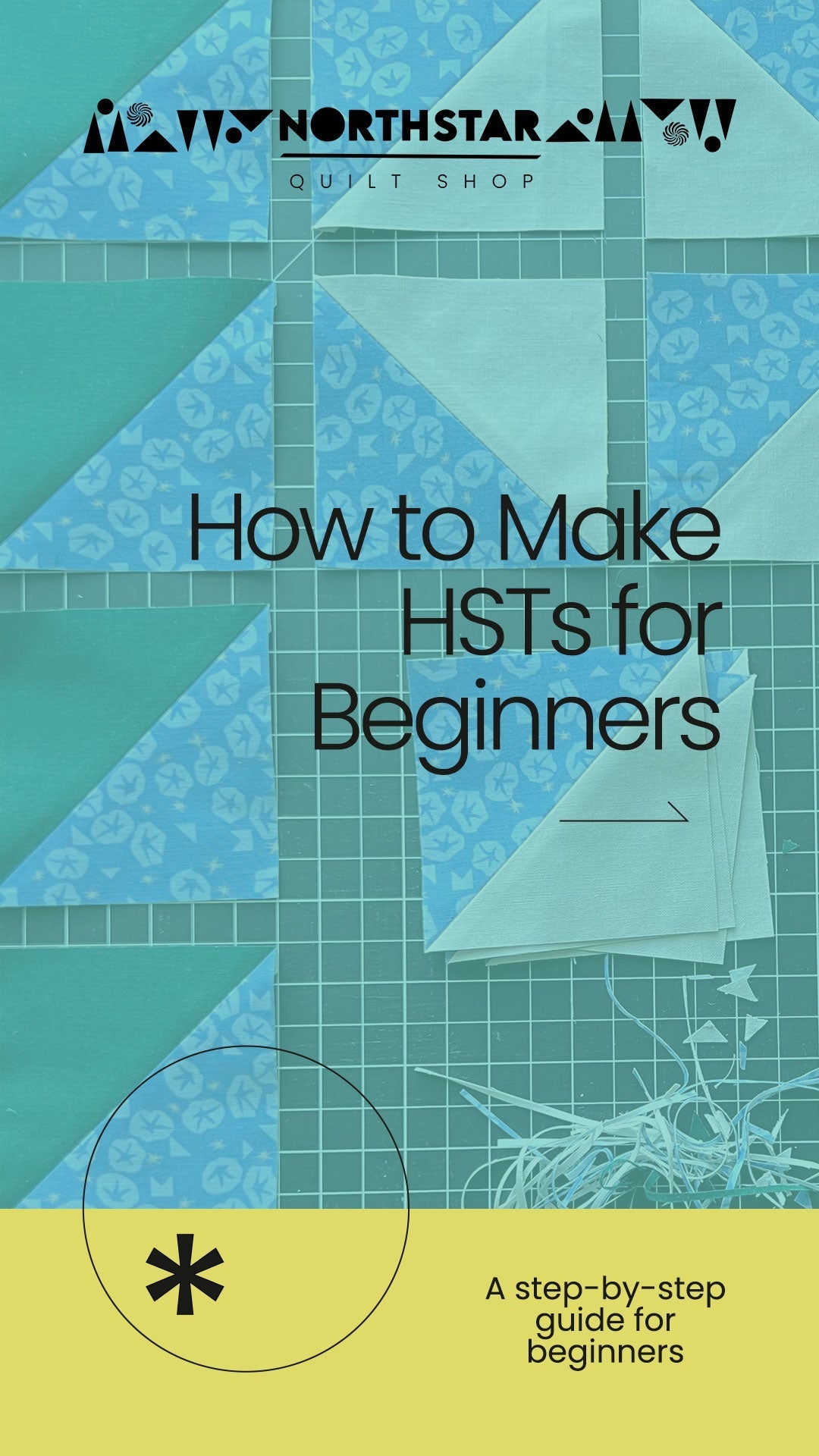
How to Make Half-Square Triangles (HSTs)
Half-square triangles, often shortened to HSTs, are one of the most versatile building blocks in quilting. Made from two triangles of fabric sewn together to form a square, they appear in everything from classic star blocks to bold, modern geometric quilts.
In this tutorial, I’ll show you how to make half-square triangles using the two-at-a-time method. We’ll walk through cutting your fabric, sewing the units, and trimming them to size, with plenty of tips to help you get accurate results. This method uses slightly oversized fabric squares, giving you extra room to practice trimming and build confidence as you go.
Once you’ve mastered the basics, you’ll be ready to experiment with all the different patterns and designs you can create with HSTs!
What Is a Half-Square Triangle?
A half-square triangle is a square quilt unit made from two right-angle triangles, usually in contrasting fabrics. The diagonal seam divides the square into two equal halves.
HSTs are wonderfully versatile. Depending on how you rotate and arrange them, you can create pinwheels, stars, diamonds, chevrons, and countless other patterns.
They're also a great skill to learn early in your quilting journey because the same basic technique can be used in hundreds of quilt patterns.
Materials and Tools
To make half-square triangles, you'll need:
- Two contrasting quilting cotton fabrics
- Rotary cutter and cutting mat
- Quilting ruler
- Fabric marking pen or pencil
- Sewing machine and thread
- Iron and pressing surface
- Pins, if desired
A North Star tip: Choose fabrics with a noticeable difference in color or value for your first HSTs. A light fabric paired with a dark one makes the diagonal design easier to see.
How to Make Half-Square Triangles: The Two-at-a-Time Method
This method starts with two squares of fabric and produces two matching HST units. We'll cut the squares a little larger than necessary, then trim the sewn units to their exact unfinished size.
Step 1: Cut Your Fabric Squares
Cut one square from each of your two fabrics. Both squares should be the same size.
For beginners, whole-number measurements can make cutting easier. The chart below uses an oversized cutting method, so you'll have a little extra fabric to work with when trimming.
Half-Square Triangle Cutting Chart
| Desired finished HST size | Cut two squares | Trim each HST to |
|---|---|---|
| 2″ × 2″ | 3″ × 3″ | 2½″ × 2½″ |
| 3″ × 3″ | 4″ × 4″ | 3½″ × 3½″ |
| 4″ × 4″ | 5″ × 5″ | 4½″ × 4½″ |
| 5″ × 5″ | 6″ × 6″ | 5½″ × 5½″ |
| 6″ × 6″ | 7″ × 7″ | 6½″ × 6½″ |
The trimmed size is called the unfinished size. It includes the seam allowance that will be used when you sew the HST into your quilt. After it's sewn into the quilt top with a ¼″ seam allowance on each side, it will measure the finished size shown in the first column.
For example, to make two HSTs that finish at 3″ × 3″, cut two 4″ squares. After sewing and cutting them apart, trim both units to 3½″ × 3½″.
Step 2: Draw a Diagonal Line
Place your two squares right sides together, matching all four edges.
On the wrong side of the top square, draw a diagonal line from one corner to the opposite corner. This line will be your guide for sewing and cutting.
Pin the squares together if that helps keep the fabric from shifting.
Step 3: Sew on Both Sides of the Line
Take your paired squares to the sewing machine.
Sew a ¼″ seam allowance on one side of the drawn diagonal line. Then sew another ¼″ seam allowance on the other side of the line.
Keep your stitching straight and your seam allowances consistent. If your machine has a ¼″ foot or seam guide, this is a good time to use it.
Step 4: Cut Along the Diagonal Line
Using your rotary cutter and ruler, cut directly along the diagonal line you drew.
Separate the two pieces. Each one will open into a square made from two contrasting triangles. You now have two half-square triangle units!
Step 5: Press Your Seams
Open each HST and press the seam with your iron.
You have two options:
-
Press to one side. Many quilters press toward the darker fabric to help prevent the seam allowance from showing through lighter fabric.
-
Press the seam open. This can reduce bulk where several seams meet.
Either option can work. If you're following a quilt pattern, use its recommended pressing direction when one is specified.
Press gently rather than dragging the iron across the fabric. The diagonal edges of an HST are on the bias, which means they can stretch if handled roughly.
Step 6: Trim Your HSTs to Size
Trimming is one of the most helpful steps for making accurate quilt blocks. Even small differences in size can add up when you're joining lots of units together.
For this oversized method, trim each HST to the unfinished measurement in the chart. For example, an HST that will finish at 3″ should be trimmed to 3½″ × 3½″.
Here's how:
- Place your HST on your cutting mat with the seam pressed flat.
- Position your square quilting ruler over the unit, aligning the ruler's 45-degree diagonal line with the diagonal seam.
- Check that the unit will be the correct unfinished size and that the seam intersects the ruler's diagonal line at the appropriate corners.
- Trim two adjacent edges.
- Rotate the unit 180 degrees, realign the ruler using the newly trimmed edges, and trim the remaining two edges.
Take your time when positioning the ruler. You want the HST to be square, with the diagonal seam running from corner to corner and enough seam allowance left beyond the points of the triangles.
Once you've trimmed both units, measure them to make sure they're the same size. They'll be much easier to piece into your quilt when their dimensions match.
Common HST Problems and How to Fix Them
Even experienced quilters occasionally have to unpick a seam or trim a block again. Here are a few common issues to watch for.
My HSTs are too small
This can happen when the seam allowance is too wide or the fabric stretches during sewing and pressing.
Try this: Check your ¼″ seam allowance on a test unit. If your HSTs consistently come out too small, a scant ¼″ seam may help. Always test the adjustment before making a large batch, and trim only after checking that your units have enough fabric to reach the required size.
My blocks look stretched or wonky
The diagonal edges of HSTs are bias edges, which are more prone to stretching than edges cut along the straight grain.
Try this: Handle the units gently, avoid pulling the fabric while sewing, and lift and lower your iron instead of dragging it across the seam.
My triangle points don't line up
Inconsistent sizing can make it difficult to match points when joining units together.
Try this: Trim every HST to the same unfinished size before assembling your quilt block. When joining pieces, check that the seam allowance leaves the triangle point intact.
My diagonal seam doesn't line up with the ruler
It can be tricky to position a ruler accurately at first, especially on small HSTs.
Try this: Use a ruler with a clearly marked 45-degree line. Align that line with the HST's diagonal seam, then check the unfinished measurement before cutting. If your ruler has multiple diagonal markings, make sure you're using the one that matches the unit size.
Quilt Designs You Can Make with Half-Square Triangles
Once you've made a few HSTs, the fun really begins! Simply turning the units in different directions can create entirely different patterns.
Here are a few arrangements to try:
- Pinwheels: Arrange four HSTs so their contrasting triangles meet in the center.
- Chevrons: Turn rows of HSTs to create zigzag lines.
- Diamonds: Arrange HSTs to form larger diamond shapes.
- Stars: Combine HSTs with squares and other quilt units to create star blocks.
- Scrap quilts: Mix a variety of prints and colors for a playful, patchwork effect.
- Modern geometric layouts: Experiment with color, contrast, and negative space to create your own design.
You can use the same HST technique at different sizes, making it easy to adapt the unit to a pattern or design of your own.
Try rotating the units in different directions and photographing the arrangements you like. A few simple HSTs can lead to a surprising number of possibilities!
Keep Building Your Quilting Skills
Half-square triangles are one of those fundamental techniques you'll return to again and again. Once you're comfortable cutting, sewing, pressing, and trimming them, you'll be ready to tackle a wide range of quilt patterns.
Looking for another foundational technique? Continue the Basic Blocks series with our tutorial on How to Make Flying Geese Quilt Blocks. Flying Geese are another versatile quilt unit that can be used in borders, stars, chevrons, and more.
Happy quilting!